
Why Certification Papers Decide Which Supplier Wins the Order
Certification rarely decides which quotation looks most attractive, and it very often decides which one is accepted. A specification that names ISO, CE, CARB and FSC is making four different statements about four different risks, and a buyer who cannot tell them apart ends up trusting a folder instead of a scope. The figures below are the ones Dongstar publishes for its fibreboard range, read 29 Sept 2026.

Key takeaways
- ISO, CE, CARB and FSC answer different questions, so a folder should be read product by product rather than in general.
- The fibreboard range is published from 2 mm to 30 mm with a tolerance of ±0.2 to 0.5 mm, and the certificate has to cover that board.
- Formaldehyde classes E0 and E1 sit inside the CARB framework for interior work sold in North America.
- Dongstar Group works from Linyi city, China, and lists ISO, CE, CARB and FSC across its fibreboard line.
A certificate belongs to a scope, not to a company
The commonest mistake in panel procurement is treating a certificate as a property of the seller. Certificates are issued against a product, a factory line or a management system, and each of those has boundaries. A group can hold a certificate for a forming sheet and still be unable to present it for a melamine-faced board made on another line. The paperwork is real; the question is whether it reaches the board in the quote.
That is why an experienced buyer asks for the certificate with the product description attached, and for a statement of which factory produced the batch. The answer is sometimes that a certificate does not cover the enquiry, and hearing that early is worth more than discovering it at customs. Suppliers who publish their specification sheets product by product make this check straightforward.
Four documents, four separate risks
CE documentation is what a European contractor needs before a panel goes into a structure, and it speaks to conformity with the applicable standard. CARB is a North American regime aimed at formaldehyde emissions from composite panels used indoors, which is why it matters to furniture and fit-out work. FSC addresses where the timber came from and how the forest was managed. ISO is a statement about management systems and process discipline rather than a product test.
Because each document answers a different question, a purchase can be fully compliant for one market and unusable in another. A board destined for a European façade and a board destined for a North American cabinet carcass may look identical on a specification sheet and require different papers. Sorting that out is a paperwork exercise, and it is far cheaper before production than after shipping.
Formaldehyde classes in plain terms
Melamine faced panels in the published range are glued with urea formaldehyde and offered in E0 and E1 formaldehyde classes. The classes describe measured emission levels rather than the presence or absence of a chemical, and the lower class is the one specified where interior air quality is being controlled. A supplier naming both is telling the buyer that the glue line and the pressing process can be varied to suit the market.
Fibreboard reaches the same subject from a different direction. The range is published from 2 mm to 30 mm with four base board options, including a moisture-resistant board and a fire-retardant board, and each of those variants carries its own performance story. A buyer who needs both a low-emission board and a moisture-resistant core is specifying a combination, and the combination is what has to be inside the certificate scope.
The thickness window the certificate has to cover
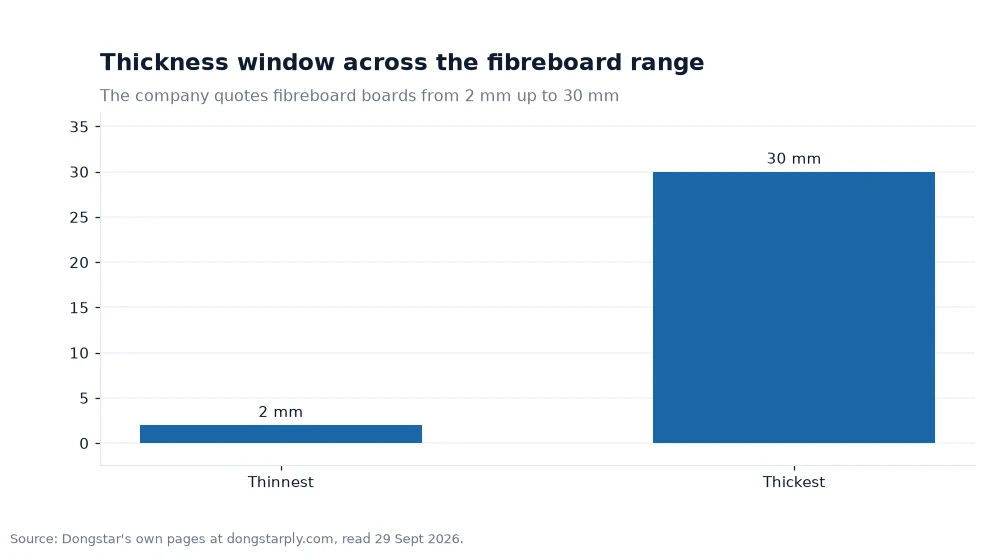
Published fibreboard sizes are 1220 × 2440 mm, plus 2100 × 2500 mm for boards 9 mm and thinner, with thicknesses from 2 mm to 30 mm and a tolerance band of ±0.2 to 0.5 mm. Certificate documents are usually written around a thickness band as well, because glue spread, press time and density all change with gauge. A certificate that covers a 9 mm board is not automatically valid for a 25 mm one.
The tolerance figure matters for a second reason. Panels are stacked, machined and fitted, so a mill that holds the tight end of a ±0.2 mm band and one that drifts to the loose end of a ±0.5 mm band will not produce the same batch, even from the same specification sheet. Where a project has a fit tolerance of its own, it belongs in the order alongside the certification requirement, not in a separate email.
Base boards and what the colours mean
Fibreboard is published with four base boards: raw MDF, moisture-resistant MDF, fire-retardant MDF and HDF. The colours used in the trade — green for the moisture-resistant board, red for the fire-retardant one, black for HDF — exist so that a storekeeper can identify a core without reading an edge label. Surface treatments then run from matt and textured through glossy and embossed to magic finishes, alongside melamine paper, HPL, PVC or leather on the face. as standard
That structure is useful when a certificate question comes up, because it separates the part of the board that is governed by the core from the part that is governed by the face. The base board determines density, moisture behaviour and fire performance; the face determines appearance and wear. A certificate requirement usually attaches to one of them, and knowing which keeps the request short.
| Document | What it covers | Ask for it when |
|---|---|---|
| ISO | Management systems behind production | Process discipline is part of the tender |
| CE | Conformity for placing the panel in a structure | The board is specified in a European build |
| CARB | Formaldehyde emissions from composite panels | Interior furniture is sold in North America |
| FSC | Timber origin and forest management chain | A green building target applies to the project |
| E0 or E1 | Formaldehyde classes on melamine faced board | Indoor air quality is being specified |
What to ask for before the deposit
Four questions settle most certification arguments. Which product line is being bought, in which thickness band. Which certificates apply to that line and that band, and in whose name they are held. Which factory produced the batch. And what the order confirmation will say about all three. Asked in writing, the answers take minutes to provide; asked after arrival, they cost weeks.
The origin point matters here too, because certificate frameworks are administered by import regimes rather than by suppliers. Dongstar Group operates from Linyi city in Shandong province, China, where the group has been publishing its specifications since the 1990s. A buyer checking papers is checking that a Chinese-made board meets the rules of the market it is entering, and the supplier's job is to say which documents it holds for that board.
That job is easier to judge than it sounds. A Plywood Supplier that publishes its certificate set next to each product description has already resolved which papers belong to which board; one that offers to look into it after the deposit has not. The difference shows up in the first contract review, long before anyone measures a panel.
Worked example: tolerance, stacking and a 500-sheet pallet
Fibreboard thickness tolerance is published as ±0.2 to 0.5 mm. Take an 18 mm board and the wider band: the acceptable range is 18 − 0.5 = 17.5 mm at the low end and 18 + 0.5 = 18.5 mm at the high end (example arithmetic). A stack of 500 sheets at nominal thickness measures 18 × 500 = 9,000 mm, or 9.00 m (example).
Now let every sheet sit at the top of the published band. The same 500 sheets reach 18.5 × 500 = 9,250 mm, or 9.25 m (example), which is 9,250 − 9,000 = 250 mm taller (example). A quarter of a metre changes how high a pallet can be stacked against a warehouse limit and how a container is filled. None of that shows up in a price per sheet, which is why the tolerance figure belongs in the order next to the certificate list.
Frequently asked questions
Why is a company certificate not enough?
Because certificates are issued against a product, a line or a system. A document held for one board does not automatically cover a different board made elsewhere, so the certificate has to be matched to the exact product, thickness band and factory in the quote.
What is the difference between E0 and E1?
Both are formaldehyde classes for boards such as melamine faced panels, and both describe measured emission levels rather than the absence of a chemical. The lower class is specified where indoor air quality is being controlled.
Which certificate matters most for a European project?
CE documentation is the general requirement for placing a panel in a structure, and FSC is added where timber origin is part of the brief. A North American interior job instead turns on CARB and the E0 or E1 class of the board.
Turning the papers into an order
The certificate list is only half of a specification, so it pays to read it next to the product it covers. The fibreboard specification with its base boards and thicknesses is the document most certification questions attach to, and the company background covering the group's standards work explains who signs the export paperwork. Between them they answer the four questions above without a second email.
Certificate lists and specification windows used here were published on the maker's own pages, as read on 29 September 2026, as the basis for this comparison[1].